
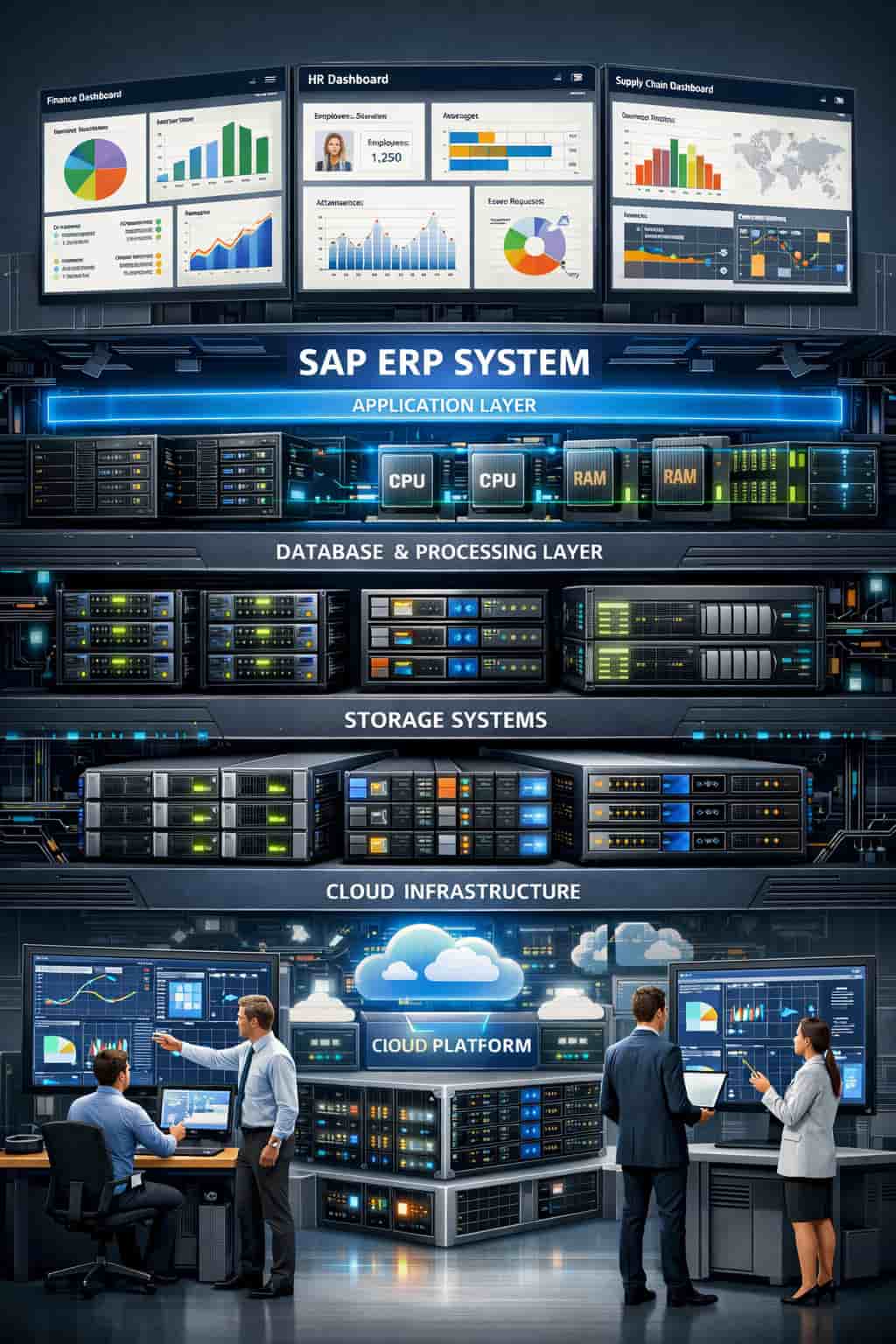
Learning about Accely SAP S/4HANA partner expertise begins with a shift in perspective. ERP systems are often discussed at the application level, modules, workflows, and business processes, but these elements represent only the visible layer of a much deeper technology stack. Beneath SAP’s interface lies a complex foundation of servers, processors, memory, storage, and network infrastructure. Expert SAP partners understand ERP not as isolated software, but as a system where application logic and hardware resources operate as a unified whole.
This full-stack view is essential in enterprise environments where performance, reliability, and scalability are non-negotiable. SAP partners with true expertise analyze how each layer of the stack contributes to system behavior, ensuring that technical decisions align with operational demands.
Aligning SAP Software with Hardware Architecture
At the core of SAP performance is the relationship between software design and hardware capability. Transaction processing, reporting, and analytics all place distinct demands on computing resources. Expert SAP partners assess these workloads and align them with appropriate hardware architectures, whether on-premise or in the cloud.
Processor selection affects parallel processing and user concurrency. Memory architecture determines how efficiently data can be cached and accessed. Storage speed influences transaction throughput and reporting responsiveness.
By understanding these interactions, SAP partners design systems that avoid bottlenecks and deliver consistent performance under real-world conditions.
Infrastructure Choices
Modern SAP environments span a range of infrastructure models. Some enterprises rely on dedicated physical servers, others operate in virtualized environments, and many adopt hybrid or fully cloud-based deployments. Each model introduces different performance characteristics and constraints.
SAP partner experts evaluate infrastructure choices by considering workload elasticity, high availability requirements, and disaster recovery strategies. In cloud scenarios, this includes selecting appropriate instance types, storage tiers, and network configurations. The goal is not simply to deploy SAP, but to ensure it operates efficiently within its chosen infrastructure context.
Reliability, Scalability, and System Resilience
Mission-critical ERP systems must remain available and responsive, even under peak load or during infrastructure disruptions. Expert SAP partners design for resilience by aligning software architecture with redundant hardware configurations and failover mechanisms.
High availability clusters, load balancing, and backup strategies are integrated into the stack from the outset. Scalability is treated as an architectural principle rather than a reactive measure. As transaction volumes grow or new users are added, the system can scale without compromising stability. This holistic approach reflects an understanding that ERP reliability is achieved through coordinated software and hardware design.
SAP Partners as Enterprise System Architects
The defining trait of an SAP partner expert is the ability to think like a system architect. Rather than focusing solely on configuration or customization, these partners bridge the gap between enterprise software and the hardware environments that power it. They translate business requirements into technical designs that account for processing capacity, memory utilization, and infrastructure constraints.
Understanding Expertise from the Inside Out
Exploring SAP partner expertise across software and hardware reveals the depth required to support enterprise operations. True expertise lies in understanding how every layer of the stack interacts to produce performance, reliability, and scalability. By approaching ERP as a unified system, SAP partner experts deliver solutions that are not only functional, but engineered to perform under the demands of modern enterprise environments.